
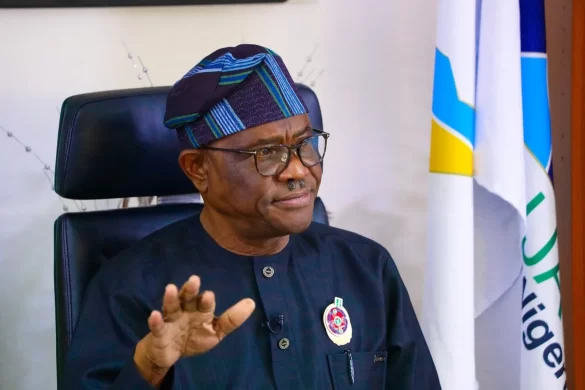


Federal Capital Territory (FCT) Minister Nyesom Wike’s expression of happiness over his inclusion in the All Progressives Congress (APC) Presidential Campaign Council has revived scrutiny of his past denunciation of the ruling party, which he once described as having “stage four cancer.”


Wike made the remark in 2021, when he was governor of Rivers State, dismissing suggestions that he would defect from the Peoples Democratic Party (PDP) to the APC.
Five years later, the former governor has welcomed his inclusion in the APC’s campaign structure for President Bola Tinubu’s re-election in 2027, despite retaining his membership of the PDP.

The development has drawn attention to the contrast between Wike’s forceful rejection of the APC in the past and his present willingness to mobilise support for its presidential candidate.

Although politicians frequently shift alliances and revise their positions as political circumstances change, Wike’s earlier description of the ruling party has made his latest move particularly striking.
The central question is what has changed between his categorical rejection of the APC in 2021 and his current enthusiasm for participating in Tinubu’s re-election campaign.
‘APC Has Stage Four Cancer’
In 2021, Wike dismissed suggestions that he would join the APC, using a medical analogy to explain why he preferred to remain in the PDP.
“If I have malaria, do I go looking for cancer?” he asked in an interview with BBC Pidgin, according to reports published at the time.
He went further to describe the APC as having “stage four cancer”, arguing that the party’s problems were more severe than those confronting the PDP.
Wike also declared that he would remain in the PDP to fight its internal battles rather than abandon the party for the ruling APC.
The comments became a defining expression of his opposition to the party and have now acquired renewed significance following his inclusion in its presidential campaign structure.
From Rejection to Campaign Council
Speaking on Tuesday during a media parley in Abuja, Wike expressed satisfaction with his inclusion in the expanded campaign council, arguing that Tinubu was right to accommodate politicians outside the APC who could contribute to his re-election.
“My thinking is that the president, in his wisdom, said there are those who are not members of our political parties but have something to offer to his re-election, and it’s proper to accommodate them,” Wike said.
He argued that Tinubu’s re-election bid should not be restricted to APC members.
“We have said that the re-election of Mr President should not just be APC, because here is a platform; the constitution does not say an individual can run, you must have a platform, and that platform is APC, which is an umbrella that people will want to use to further their political ambition,” he said.
Expressing his satisfaction with the arrangement, Wike added: “That gives the holistic view that there are those who are ready for Mr President to be re-elected to continue the good work we think he’s doing for Nigeria, and we’re happy to be part of it.”
Under the revised campaign structure, Wike will coordinate Tinubu’s presidential campaign in Rivers State and the FCT.

His inclusion comes despite his continued membership of the PDP, under whose platform he served as Rivers State governor for eight years.
Wike’s Political Calculus
Wike’s relationship with the APC has evolved considerably since his 2021 remarks.
Although he remained in the PDP, he supported Tinubu’s emergence as president in 2023 and subsequently accepted appointment as FCT minister in the APC-led administration.
His support for Tinubu has continued despite disagreements within the PDP over his political choices and his relationship with party members who oppose his position.
Wike has maintained that backing Tinubu’s re-election does not require him to abandon the PDP. He has also argued that politicians can support a presidential candidate from another party while retaining their own party membership and pursuing different interests in other elections.
In August 2026, he reportedly ruled out serving as director-general of Tinubu’s presidential campaign, saying he was not an APC member and that joining the party’s presidential campaign council was “out of the question”.
He said his priority was to secure support for Tinubu in Rivers State and the FCT rather than pursue a national campaign position.
His subsequent inclusion in the expanded council, followed by his expression of happiness over the appointment, marks another development in his relationship with the ruling party’s campaign machinery.
A Question of Political Consistency
Wike’s political journey continues to attract attention because of the contrast between his earlier denunciation of the APC and his subsequent cooperation with its leadership.
The issue extends beyond his decision to support Tinubu to the forceful language he used when rejecting the possibility of joining the ruling party.
Politicians routinely change alliances, reconsider positions and enter into arrangements shaped by evolving political circumstances. In Wike’s case, however, the strength of his earlier “stage four cancer” description makes his present enthusiasm particularly noteworthy.
His current position raises questions about whether he has reassessed the party he once criticised, whether he distinguishes between party membership and support for an individual candidate, or whether his decision reflects the practical demands of political alliances.
Wike’s own explanation is that supporting Tinubu does not require him to leave the PDP and that the APC’s presidential platform can accommodate politicians from other parties.
The expanded campaign council also includes Anambra State Governor Chukwuma Soludo of the All Progressives Grand Alliance (APGA) and Osun State Governor Ademola Adeleke, who won his election on the platform of the Accord Party. Their inclusion points to the campaign’s effort to attract support beyond the APC’s formal membership ahead of the 2027 presidential election.
However, Wike’s position presents an additional political complication: the PDP has its own presidential candidate, Professor Sandy Onor, meaning that the minister’s support for Tinubu places him at odds with his party’s presidential campaign.
As the 2027 election approaches, Wike’s political trajectory highlights the tension between party loyalty, personal political choices and the pursuit of alliances across party lines.
Whether voters view his position as pragmatic political realignment or a departure from his earlier declarations will be left to public judgment. What remains clear is that his “stage four cancer” remark has taken on a new significance in light of his present role in Tinubu’s re-election campaign.

