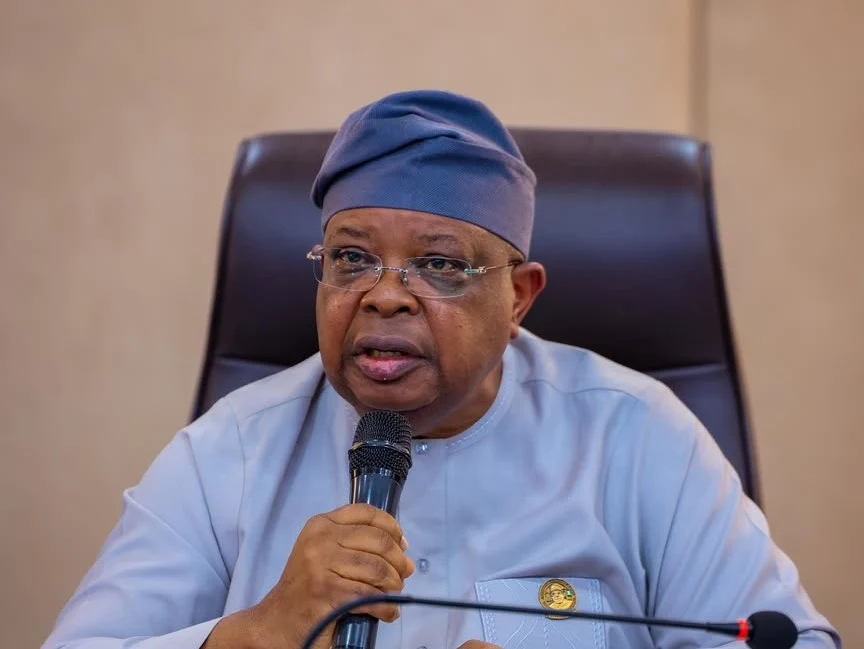


The Minister of Power, Joseph Tegbe, has said the Federal Government can no longer continue to cover electricity tariff shortfalls and be expected to provide power to every Nigerian.


Tegbe said this at an energy conference organised by the Harvard Business School Association of Nigeria in Lagos on Friday, where energy experts and regulators discussed the nation’s energy challenges and the way forward.
According to Tegbe, the government is working to address structural problems in the electricity market, including poor revenue collection, inadequate metering, accumulated debts to power generation companies and weaknesses in the existing market structure.

He emphasised that the failure of operators in the electricity value chain to recover their costs was one of the reasons the country could not keep the lights on. “Commercially viable pricing will work where the supplier can actually collect his money and get paid. There’s no sense in commercially viable pricing if you don’t collect money,” he said.

The minister stated that the government was reviewing the electricity market structure and tariff assumptions with the Nigerian Electricity Regulatory Commission to address problems affecting the sector.
He questioned the continued role of the NBET model, which buys electricity in bulk and sells it to distribution companies without recovering costs, saying the company ought to have been brought to a planned end.
“As for NBET, we know that every human being, even businessmen in this room, would take opportunities where they see it. NBET as a government entity today buys bulk, sells bulk. Because it’s the government, people take advantage.
“Now, NBET ought to have been sunset about five years ago, and I’m telling you my own plan, at the end of the day, is to move from that model. That model will not help Nigeria. We can’t keep covering tariff shortfalls and think we’ll give power to every Nigerian,” Tegbe declared.
He said the government was planning to move towards bilateral electricity agreements, under which power producers would supply customers or distribution companies based on agreed commercial terms.
“All we need to do is move to bilateral agreements. And we already have bilateral agreements working. Mainstream is supplying the Abuja and Ikeja DisCos, and they pay, because Mainstream will supply you what you pay for,” he said.
Tegbe argued that the distribution end of the electricity value chain needed urgent attention, noting that Nigeria had a 40 per cent metering gap.
Add us to your Preferred Sources
“In the power sector today, we’re trying to fix the down end of the problem, which is the distribution end. We have a 40 per cent metering gap in Nigeria today. If you don’t meter, how do you get people to pay? So this government, in the last six months, has deployed over 700,000 meters across the country. Our plan is to deploy 7.5 million meters in the next two to three years,” Tegbe said.
He also cited aggregate technical, commercial and collection losses of more than 44 per cent, explaining that the sector was unable to collect enough revenue from the electricity supplied to consumers.
According to him, the losses had contributed to the accumulated debt owed to generation companies, which he put at about N3.3tn.
“Now, we put in a bond; we paid about N1.2tn to N1.3tn today, and successfully, we plan to finish paying by next year. But again, it’s not just paying backlog or legacy debt. The plan is: how do we ensure it doesn’t happen anymore?” he asked.
Tegbe added that the government was considering the use of independent transmission lines to connect underutilised power plants to industrial clusters with high electricity demand.
He cited plants in the Niger Delta axis, including Alaoji, which he said were built to generate a combined 3,000 megawatts but were producing barely 400MW.
The minister said the government was also reviewing transmission infrastructure, undertaking technical audits and planning to prioritise investments in areas with the greatest electricity demand.
Speaking, energy expert Gbite Adeniji said resolving the power sector’s liquidity crisis required the government to clear outstanding debts and provide NBET with credible financial backing.

He said the inability of gas suppliers to receive payment for supplies to power plants was affecting the entire electricity value chain.
“The issue is whether that demand is as effective as it should be, that is, can people pay for the gas that they procure? Once you can resolve that issue, you’ll find that there’ll be far more uptake of gas,” Adeniji said.
He argued that NBET needed a stronger balance sheet to enable it to meet its obligations to power producers and, in turn, support payments to gas suppliers.
Adeniji said the government’s effort to clear the debt backlog was important for restoring investor confidence, warning that the prevailing conditions were discouraging investment in new power plants for grid supply.
He also called for closer scrutiny of upstream gas costs, arguing that inefficiencies could be passed on to power-sector consumers through gas prices.
“But I think that there needs to be a closer look at the upstream that supplies gas to power, because I keep hearing the upstream complain about this pricing. If there’s not sufficient regulatory control over upstream costs, what you have is a tendency of the upstream to want to pass on the inefficiencies in procurement into their pricing arrangements for power,” he said.
He also called on the midstream regulator to pay closer attention to the Gas Aggregation Company of Nigeria, which implements the domestic gas supply obligation.
Adeniji said the company needed to ensure that commercial agreements intended to facilitate domestic gas supply were implemented effectively.
Also, the Chief Executive of the NUPRC, Oritsemeyiwa Eyesan, said the sector had faced challenges with gas pricing and payment collection, while legacy debts owed to upstream operators had affected the market.
She said a debt resolution arrangement involving royalty gas had helped address some of the outstanding obligations, while the government’s bond initiative was also providing a clearer path towards resolving the debt.
“We had a resolution structure where there was the debt write-off through the royalty gas. That helped a bit. But that still left a headroom unpaid. And now we talked about the bond that the government also introduced, and that is at least showing that it’s working, so there’s a line of sight,” she said.
Eyesan also highlighted the importance of gas infrastructure in expanding supply across the country, noting that the completion of the OB3 pipeline was significant for distributing gas from the south to the north.
“Unfortunately, this took us several years. It was only this year that NNPC finally announced the completion of the OB3 line. That is the major line that takes gas, distributes, enables, and unlocks gas distribution from the south to the north and beyond,” she said.
The NUPRC chief executive also pointed to the Petroleum Industry Act’s drill-or-drop mechanism, which requires operators to develop assets rather than leave them idle.
Meanwhile, the Chief Executive of the NMDPRA, Rabiu Umar, dismissed suggestions of regulatory friction between the two petroleum regulators, saying they were working together to improve the investment environment.
“There is no regulatory friction between NUPRC and NMDPRA, and I’d like to repeat that. There is no regulatory friction between NUPRC and NMDPRA,” Umar said.
He said the Petroleum Industry Act was still being implemented and that the regulators were working to provide an environment that would encourage investment in gas projects.
He also said the Midstream and Downstream Gas Infrastructure Fund was designed to support investment and reduce risks associated with gas projects.
Punch

